
· Rangers, Scottish Football Museum and archive accounts checked 19 November 2026
When did Graeme Souness become Rangers manager?
Rangers’ own 40th-anniversary account dates his unveiling to 8 April 1986. Chief executive David Holmes brought him to Ibrox as player-manager after his time with Sampdoria. The Scottish Football Museum places that move after a Liverpool career that had established him as one of Europe’s leading midfielders.
The challenge was immediate. Rangers had not won the league since Jock Wallace’s 1977/78 treble season. Souness inherited a club that needed to regain consistency, rather than a reigning champion looking for a final adjustment. Walter Smith joined as his assistant, providing coaching experience alongside a first-time manager.
Jock Wallace and the championship years before Souness
What changed during the Souness revolution?
The arrivals of Terry Butcher, Chris Woods and Graham Roberts during 1986 showed the scale of Rangers’ recruitment ambitions. The Rangers Archives connects the movement of prominent England players to the exclusion of English clubs from European competition following the Heysel disaster. That context helped make Scotland attractive, but it should not reduce every player’s decision to one explanation.
The revival also depended on players already at Ibrox. The archive highlights Ian Durrant and Derek Ferguson’s development and the renewed contributions of Davie Cooper and Ally McCoist. Souness’s reputation for demanding standards mattered, but the side was not built entirely from new recruits. Reading the careers of Cooper and McCoist alongside this account gives a fuller picture of the transition.
The league title returns to Ibrox
Rangers won both the League Cup and league championship in Souness’s first season, 1986/87. The league success ended a nine-year wait. The following season did not produce another championship; the title returned in 1988/89 and was retained in 1989/90.
The Scottish Football Museum credits Souness with 3 Scottish league titles and 4 League Cups before his move to Liverpool. Those completed championship seasons are 1986/87, 1988/89, 1989/90. This is different from saying he personally managed Rangers through all nine consecutive championships.
Why do sources give different title totals?
The Rangers Archives’ managerial honours table lists 4 league wins for his 1986–91 tenure, while the Scottish Football Museum lists three before he left. The distinction matters because Souness departed during the 1990/91 campaign, before the championship was secured under Walter Smith. We retain both source scopes rather than silently treating the table as four title-clinching seasons managed by Souness.
The long championship sequence began in 1988/89, not with the separate 1986/87 success. Souness started that sequence; Smith carried it through to the ninth consecutive title in 1996/97. The handover deserves its own place in the story, particularly when visitors compare the two managers’ legacies.
Souness the player and Souness the manager
His two roles generate another statistical trap. The archive’s player record lists 73 competitive appearances and 91 appearances in its wider all-match record. Those are not the number of matches he managed. Its separate manager page counts 257 competitive games in charge.
His first competitive Rangers match was the 2–1 defeat at Hibernian on 9 August 1986, in which he was sent off. That difficult beginning contrasts with the season’s eventual league and League Cup success. It is useful context for a career often remembered only through its transformation of the club.
What remains of his Ibrox legacy?
Rangers’ 2024 tribute described Souness as a driving force in the return to sustained success. His impact belongs beside, rather than instead of, the work of Holmes, Smith and the players. Richard Gough’s captaincy and McCoist’s goals continued across the managerial handover, helping connect the early revival to the later championship run.
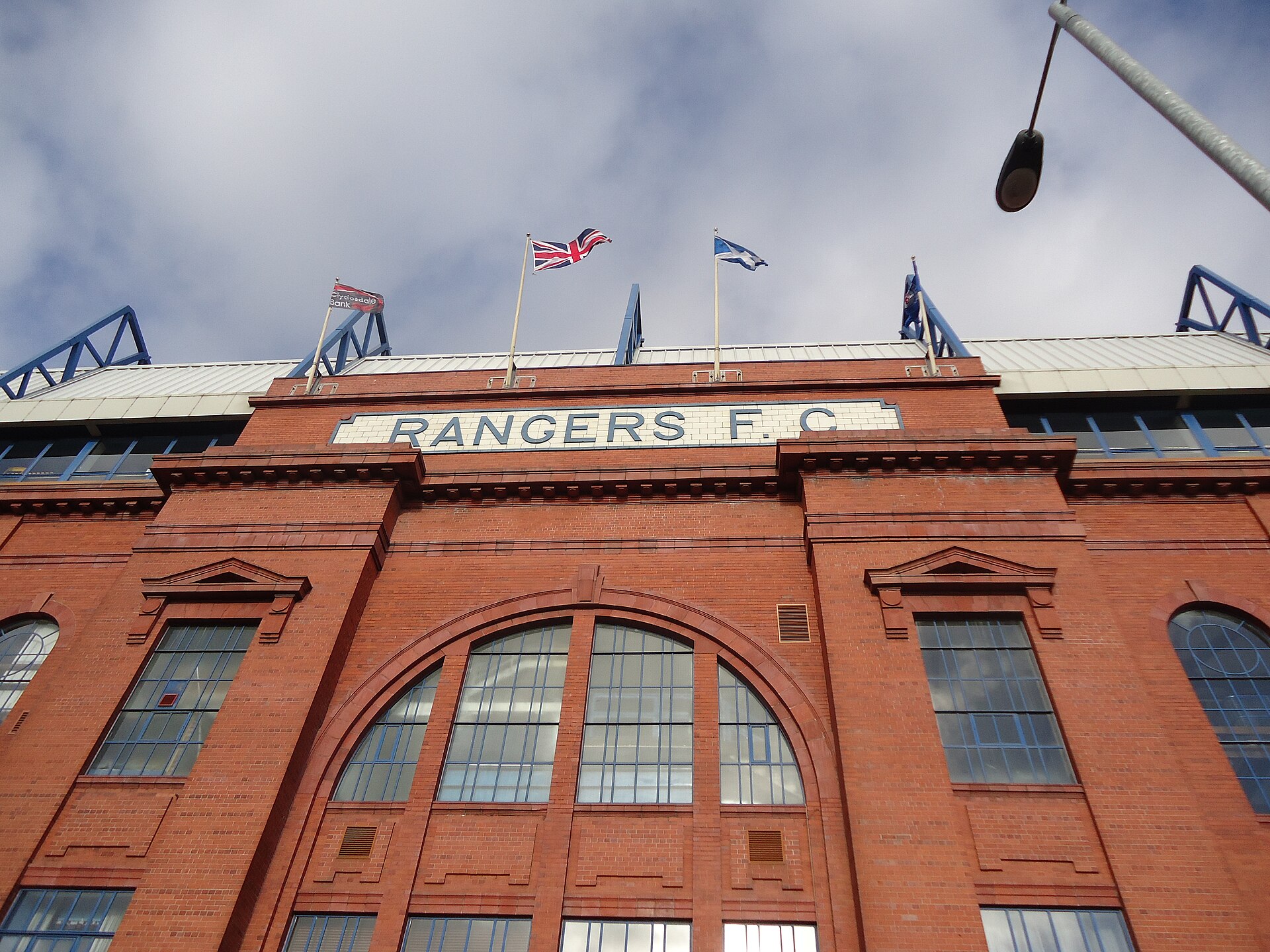
For a visit today, the Main Stand and the Rangers Museum provide settings in which to explore that history. The photograph on this page shows the entrance in 2012, not the 1986 unveiling, and we do not promise a currently displayed Souness object or a themed tour. Check the museum’s current listing if a particular exhibit is the purpose of your trip.