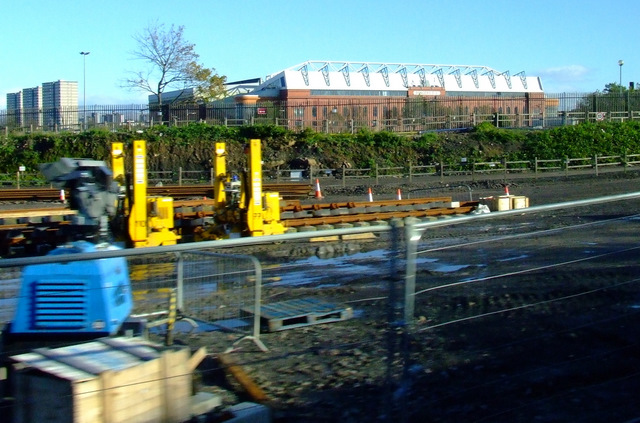
Rangers’ home since 1899
Ibrox Stadium facts & capacity
Quick, sourced answers about the stadium: how many it holds, where it is, the stands, the pitch and the story behind the name.
Ibrox in the wider neighbourhood · 19 October 2011 · Thomas Nugent · Photograph source · CC BY-SA 2.0. Cover cropped; documentary venue view, not a current facilities or entrance plan.

Ibrox at a glance
- Capacity
- 50,987
- Seats, per Rangers’ investor information. Many references quote 51,700.
- Opened
- 30 Dec 1899
- As Ibrox Park; renamed Ibrox Stadium in 1997.
- Pitch size
- 105 × 68 m
- Not confirmed by Rangers; reference figure (Wikipedia).
- Record crowd
- 118,567
- Rangers v Celtic, 2 Jan 1939. Reference figure, not confirmed by a current Rangers page.
- Address
- 150 Edmiston Drive
- Glasgow G51 2XD.
- Owner
- Rangers
- Home of Rangers since 1899.
Figures as published by reference sources; capacity can change with stand works and certification.
Questions about Ibrox
Each answer links to its source. Visiting soon? Our visitor FAQs cover bags, entry and families.
What is the capacity of Ibrox Stadium?
Rangers’ own investor information describes Ibrox as a 50,987-seat stadium. Many press and reference sites quote 51,700; we use the club’s figure. Either way it is the third-largest football stadium in Scotland, and usable capacity can change with stand works and safety certification.
Where is Ibrox Stadium?
Ibrox stands on Edmiston Drive in the Ibrox area of Glasgow, south of the River Clyde and next to Govan. The address is 150 Edmiston Drive, Glasgow G51 2XD. Ibrox Subway station is a short walk away.
What is Rangers’ stadium called?
Rangers play at Ibrox Stadium, known as Ibrox Park from 1899 until 1997. Supporters and broadcasters usually simply call it Ibrox.
What are the stands at Ibrox called?
The four stands are the Bill Struth Main Stand, the Sandy Jardine Stand opposite, and the Copland Stand and Broomloan Stand behind each goal.
Who owns Ibrox Stadium?
Ibrox is owned by Rangers Football Club, which has played there since the ground opened in 1899.
How big is the Ibrox pitch?
Reference sources give the playing surface as 105 by 68 metres (about 114.8 by 74.3 yards), with a hybrid grass surface since 2021. We could not confirm the dimensions in a current Rangers publication.
What was the biggest crowd at Ibrox?
Reference sources record a British league record crowd of 118,567 watching Rangers play Celtic in January 1939, when the ground still had huge open terraces. We could not confirm the figure on a current Rangers page. Today’s all-seated capacity is far lower.
What does the name Ibrox mean?
The origin is uncertain. It is often linked to the Gaelic àth bruic, ‘badger ford’, though other explanations exist. The stadium takes its name from the surrounding Ibrox district.
Is the Main Stand a listed building?
Yes. The red-brick Bill Struth Main Stand, designed by Archibald Leitch and completed in 1929, is Category B listed by Historic Environment Scotland.
How do I get tickets for Ibrox?
Match tickets are sold through Rangers’ official ticketing channels; stadium tour and museum tickets are booked separately. Avoid unofficial resale sites.
Is there parking at Ibrox?
Parking may be restricted or unavailable on matchdays and local restrictions apply, so check Rangers’ fixture-specific advice before driving. Public transport is usually the easier option.
When did Ibrox open?
The present Ibrox opened on 30 December 1899, when Rangers beat Hearts 3–1. An earlier Ibrox, used from 1887, stood just east of the current site.
When were floodlights first used at Ibrox?
The Ibrox floodlights were switched on for a friendly against Arsenal on 8 December 1953. Arsenal won 2–1.
Is the Ibrox Main Stand a listed building?
Yes. Archibald Leitch’s Bill Struth Main Stand, opened in 1929, has been Category B listed since 1987 (Historic Environment Scotland reference LB33338). The listing covers that stand, not the whole stadium.
What else happens at Ibrox besides football?
Ibrox has hosted major concerts and the 2014 Commonwealth Games rugby sevens, and Edmiston House beside the stadium holds the Rangers Museum and an events venue.