In remembrance
The Ibrox disasters
Remembering the people who went to a football match and did not come home.
The tragedies of 1902, 1961 and 1971 belong to the history of Ibrox, but their meaning reaches far beyond the stadium. Each death left a family, friends and a community grieving. This account follows the events, the people affected and the changes that followed.
Separate tragedies, shared remembrance
- 5 April 1902
- The terrace collapse during the Scotland–England international.Robert S. Shiels’ historical study
- 1961
- An earlier fatal incident on Stairway 13, distinct from the 1971 disaster.Rangers remembrance account
- 2 January 1971
- The Stairway 13 crowd crush and the families and communities affected.National Records of Scotland
Tragedy, inquiry and remembrance
A remembrance timeline
The tragedies below were separate events. Later entries record the inquiry and commemorations, not further disasters. Dates describe the events themselves, rather than when a source was published.
Tragedy
The western terrace collapse
Twenty-five people died after timber terracing collapsed during the Scotland–England international. This was a structural collapse, separate from the later Stairway 13 tragedies.
Robert S. Shiels’ historical study · LA84 Digital LibrarySeparate tragedy
Earlier loss on Stairway 13
Two people died in an incident on the exit stairway, ten years before the 1971 disaster. Rangers’ cited remembrance account establishes the year; this entry does not assign an unverified day or month.
Rangers · Always RememberedTragedy
The Stairway 13 crowd crush
Sixty-six supporters died as people leaving the Rangers–Celtic match became trapped in a crush on the exit stairs. This was a separate event from both the 1902 collapse and the 1961 incident.
National Records of Scotland · Scotland’s PeopleInquiry
The Fatal Accident Inquiry begins
Proceedings opened at Pollokshaws Burgh Hall and lasted seven days. The inquiry examined the deaths; the wider Wheatley investigation subsequently considered crowd safety at sports grounds.
National Records of Scotland · inquiry historyRemembrance
Fifty years after the 1971 disaster
Rangers marked the fiftieth anniversary with an account remembering the 66 supporters, the communities affected and the club’s response. This date marks commemoration, not another tragedy.
Rangers · fiftieth-anniversary remembranceRemembrance
A service at the Ibrox memorial
John Greig and Rangers directors gathered for a memorial service. Greig laid a wreath on Edmiston Drive, remembering the 1971 victims and those lost in other stadium tragedies.
Rangers · memorial service report
Selected milestones, not a complete record of every commemoration. Sources reviewed 3 November 2026.
2 January 1971: Stairway 13
Sixty-six people died in a crowd crush at Ibrox on 2 January 1971. Rangers had been playing Celtic, and the disaster occurred on Stairway 13, an exit route from the ground.
The loss reached far beyond Glasgow. Families and communities were left grieving for supporters who had travelled to enjoy an afternoon of football.
The match and the exit stairway
It was a cold, misty afternoon. The match remained goalless until its final minutes, when Jimmy Johnstone put Celtic ahead and Colin Stein equalised for Rangers. The game ended 1–1, but the dramatic finish was soon overshadowed by events on an exit stairway at the east end of the ground.
Stairway 13 carried supporters down from the crowded terracing. Scotland’s People, drawing on the official records, describes people falling on the stairs as others continued to descend behind them. Supporters further back could not see what was happening ahead. The resulting pressure left people trapped in a crush.
The crowd crush should not be reduced to the familiar story that fans turned back after a late equaliser. The match’s final goals are part of the chronology, but do not establish the cause of the disaster.
Accounts give different injury totals. This guide does not present a single figure as settled.
The people behind the number
Rangers’ remembrance account records that 31 of those who died were teenagers. The youngest was nine-year-old Nigel Pickup, who had travelled from Liverpool. Eighteen-year-old Margaret Ferguson, from Maddiston near Falkirk, was the only woman among the fatalities.
Five schoolboy friends travelled together from Markinch in Fife; none returned home. Four lived in the same street. Their loss shows how one afternoon at Ibrox could leave an entire community mourning, far from Glasgow. Remembering these details matters because the figure of 66 alone cannot describe the lives that were lost.
A response beyond football rivalry
Help and condolences came from across Scotland and beyond. Rangers and Celtic supporters shared in the mourning, and clubs contributed to relief funds for the families. A combined Rangers and Celtic team played a Scotland XI at Hampden to raise money.
Manager Willie Waddell arranged for Rangers players to attend victims’ funerals and visit injured supporters in hospital. The national archive records that 20 funerals took place in Glasgow on one day alone. The aftermath was not simply a matter of rebuilding a stadium: it was also the long work of supporting bereaved families and survivors.
Read the National Records of Scotland account5 April 1902: the first disaster
Twenty-five people died after a section of the western terracing collapsed during a Scotland–England international at Ibrox Park on 5 April 1902. Hundreds were injured.
Historical accounts describe the collapse and its aftermath, but injury estimates differ. A definitive technical explanation should not be inferred from a short summary.
An international at a young ground
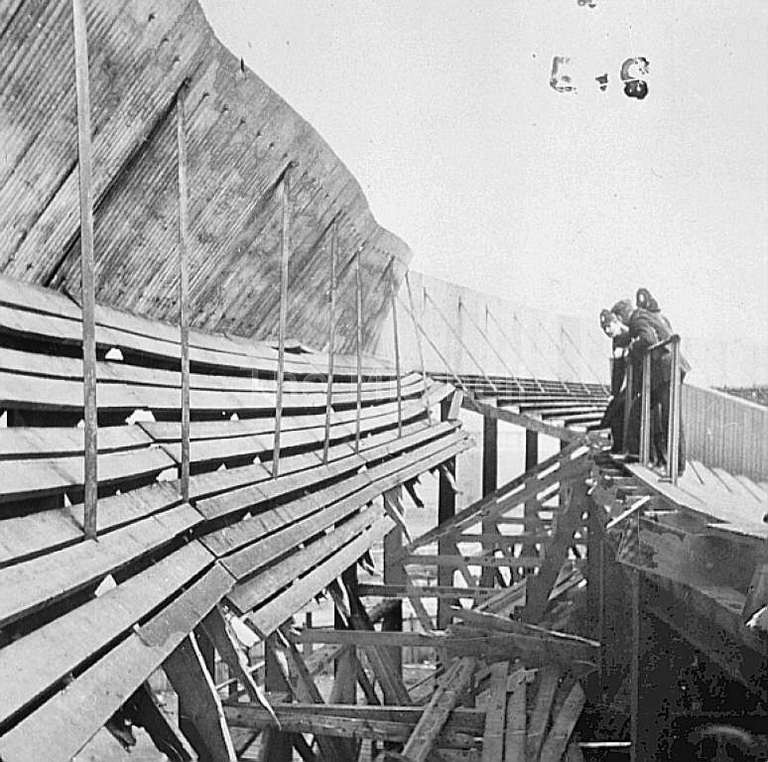
The present Ibrox ground had opened in 1899, only a few years before the disaster. The Scotland–England international brought spectators to a stadium built around large standing terraces. Part of the western terrace was supported by timber; when a section gave way, spectators fell into the space beneath it.
The archive photograph below records the damaged structure after the collapse. It is evidence of the aftermath, not a picture of the moment the terrace failed. Nor should a single photograph be used to claim a complete explanation of the engineering failure.
The match and its aftermath
Rangers’ historical account notes that play continued, with many spectators elsewhere in the ground unaware of the disaster. The international was subsequently replayed at Villa Park in Birmingham the following month. That match finished 2–2, and its proceeds supported the disaster relief fund.
The fatalities deserve attention in their own right, rather than appearing only as a prelude to 1971. Historian Robert S. Shiels examined the deaths in his article The Fatalities at the Ibrox Disaster of 1902, available through the LA84 Digital Library. It offers a more detailed study than a brief stadium-history summary.
Read Robert S. Shiels’ study of the 1902 fatalities1961: earlier loss on Stairway 13
Ten years before the 1971 disaster, two people died in an incident on Stairway 13. Rangers’ remembrance account also records further non-fatal incidents on the stairway in the intervening years.
These earlier events are part of the history of the exit route and of crowd safety at Ibrox. They should not disappear from remembrance simply because the loss in 1971 was so much greater. The memorial outside the stadium commemorates the tragedies of 1902, 1961 and 1971 together.
The memorial at Ibrox
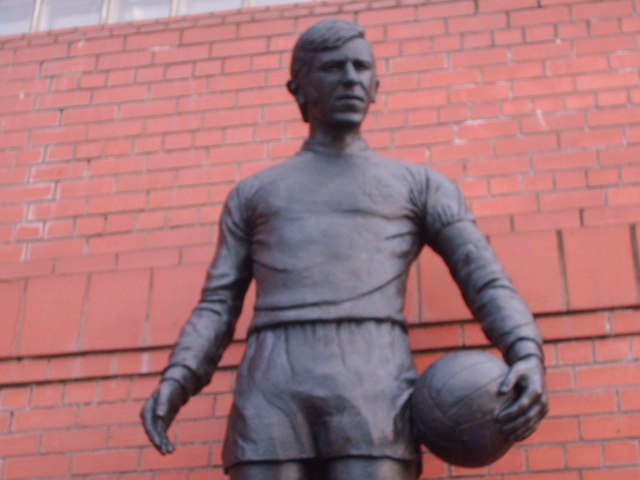
The memorial outside the Main Stand includes a statue of John Greig. It remembers those who died in the stadium tragedies of 1902, 1961 and 1971.
Rangers holds remembrance ceremonies and lays wreaths at the memorial. If you visit, take a quiet moment and respect anyone who is there to remember a loved one.
John Greig was Rangers’ captain at the time of the 1971 disaster. His presence in the memorial links the club’s public history with its continuing responsibility to remember the supporters who died. Rangers’ account of the anniversary service in January 2022 records Greig laying a wreath at the memorial on Edmiston Drive.
Anniversaries provide a shared moment of remembrance, but the consequences did not end with the first services or the opening of a memorial. For families and survivors, this remains a personal history as well as a public one.

After the tragedy
Inquiries, safety and rebuilding
The 1971 disaster led to a Fatal Accident Inquiry, which began in February that year. Scotland’s People records seven days of proceedings and evidence from 102 witnesses, excluding family members. The inquiry considered the sequence of falls and the crush on the stairway.
A wider investigation led by Lord Wheatley examined crowd safety at sports grounds. Its work went beyond Ibrox, reviewing arrangements across British football and questioning whether long-established safety practices were still adequate.
The national archive’s account describes recommendations for statutory licensing and a central code of minimum safety standards. It also highlights concerns about facilities for police, first-aid and ambulance services, and how those involved in crowd control worked together.
At Ibrox, Waddell helped drive the redevelopment that followed. The replacement stands of the late 1970s and early 1980s changed the stadium’s layout and moved it away from the old terraced ground. Those building phases are covered separately in our development guide; they should not be mistaken for the entire story of safety reform.
Sources and image credits
Historical sources
- National Records of Scotland / Scotland’s People: the 1971 disaster
- Rangers: Always Remembered (2021)
- Rangers: Forever in Our Hearts (2026)
- Robert S. Shiels: The Fatalities at the Ibrox Disaster of 1902
- Rangers: memorial service (2022)
Image credits and reuse
John Greig at the Ibrox Disaster Memorial
Photographed 22 March 2008 by Lynn M Reid. Reused under Creative Commons Attribution–ShareAlike 2.0 (CC BY-SA 2.0). The original image is displayed uncropped at a reduced size; no other changes have been made.

Damaged timber terracing after the 1902 disaster
Photographer unknown; dated 1902, with the exact photograph date not established. Wikimedia Commons identifies this archive photograph as public domain, rather than Creative Commons licensed. It is displayed uncropped at a reduced size.

Historical sources reviewed 3 November 2026.
Other places to visit around Ibrox
Walter Smith’s statue honours the manager; it is separate from the John Greig disaster memorial. Edmiston House nearby houses the Rangers Museum.