

· Contemporary Rangers, UEFA and BBC reports and match archives checked 21 November 2026
What did Rangers win in 2002/03?
The three trophies were the Scottish League Cup, Scottish Premier League and Scottish Cup. Rangers beat Celtic 2–1 in the League Cup final on 16 March 2003, secured the league with a 6–1 win over Dunfermline Athletic on 25 May, then beat Dundee 1–0 in the Scottish Cup final on 31 May. Both cup finals were at Hampden; the title-clinching match was at Ibrox.
McLeish was in his first full season as Rangers manager. Ferguson’s captaincy connected the midfield to the leadership of the side, but this was a collective achievement. The decisive games brought goals from Claudio Caniggia, Peter Løvenkrands, Michael Mols, Shota Arveladze, Ronald de Boer, Steven Thompson, Mikel Arteta and Lorenzo Amoruso.
Barry Ferguson’s captaincy and two Rangers spells
16 March: the League Cup comes first
Caniggia put Rangers ahead in the 23rd minute at Hampden, and Løvenkrands made it 2–0 in the 35th. Henrik Larsson’s 57th-minute goal brought Celtic back into the final. A two-goal interval lead had therefore become a much less comfortable one-goal margin.
The archive records Neil Lennon’s dismissal in the 88th minute and John Hartson’s missed penalty at the end of the match. Rangers held on to win 2–1. This was the first part of the treble, not the match that secured the championship: the league race continued for more than two months.
Why goal difference mattered on the final day
Rangers finished the league with 97 points, 101 goals scored and 28 conceded. Their goal difference was therefore +73; Celtic’s was +72. The championship margin was one goal of goal difference, not one league point.
UEFA’s contemporary report says the clubs began the final afternoon level on points and goal difference, with Rangers ahead on goals scored. Rangers hosted Dunfermline while Celtic travelled to Kilmarnock. The provisional lead could move as goals went in at either ground, so following the Ibrox score alone did not tell supporters who would finish first.
25 May: six different scorers at Ibrox
Mols opened the scoring before Jason Dair equalised for Dunfermline. Caniggia restored Rangers’ lead and Arveladze made it 3–1 before half-time. De Boer and Thompson then took the score to 5–1. Unlike Negri’s five-goal afternoon six years earlier, this was a win built from several different scorers.
Celtic won 4–0 at Rugby Park. At Ibrox, Arteta converted an added-time penalty after Neil McCann was brought down, completing the 6–1 scoreline. The BBC’s match report describes the tension while Celtic’s game was still being played. The penalty gave Rangers their eventual one-goal advantage in goal difference; without it, the final goal-difference totals would have been level, leaving goals scored relevant.
The archive records 49,731 spectators at Ibrox. It rounds Arteta’s penalty to minute 90, whereas Dunfermline’s contemporary listing gives 93. Added time is the useful common description rather than a falsely exact reconciled minute.
31 May: Amoruso completes the treble
The Scottish Cup final was not another free-scoring exhibition. Dundee threatened early: Barry Smith hit the post and Stefan Klos had to deny Steve Lovell. Rangers also came close when Mols headed against the crossbar. The score remained 0–0 at half-time.
Amoruso headed Neil McCann’s free-kick past Julian Speroni for the only goal. Rangers’ contemporary account places it after 65 minutes; UEFA records the 66th minute. Both identify the same winning header. Dundee continued to threaten, with a Kevin Muscat intervention diverting a Nacho Novo effort, but Rangers held on for a 1–0 victory.
That result completed the seventh domestic treble in Rangers’ history. Dundee, the Scottish Cup opponent, must not be confused with Dundee United, whom Negri had faced in 1997. The title and the treble also have different completion dates: 25 May and 31 May respectively.
What makes this treble distinct?
The three decisive matches show different sides of the team: defending a reduced lead against Celtic, scoring repeatedly under final-day pressure and finding one winning goal against Dundee. Reducing the season to Arteta’s penalty misses the two cup finals; treating the Scottish Cup final as the title decider reverses the chronology.
This was a domestic treble, not a European trophy season. It belongs to a later Rangers generation than Walter Smith’s nine-in-a-row team, and to a different managerial era from Jock Wallace’s 1970s trebles.
Exploring the season on an Ibrox visit
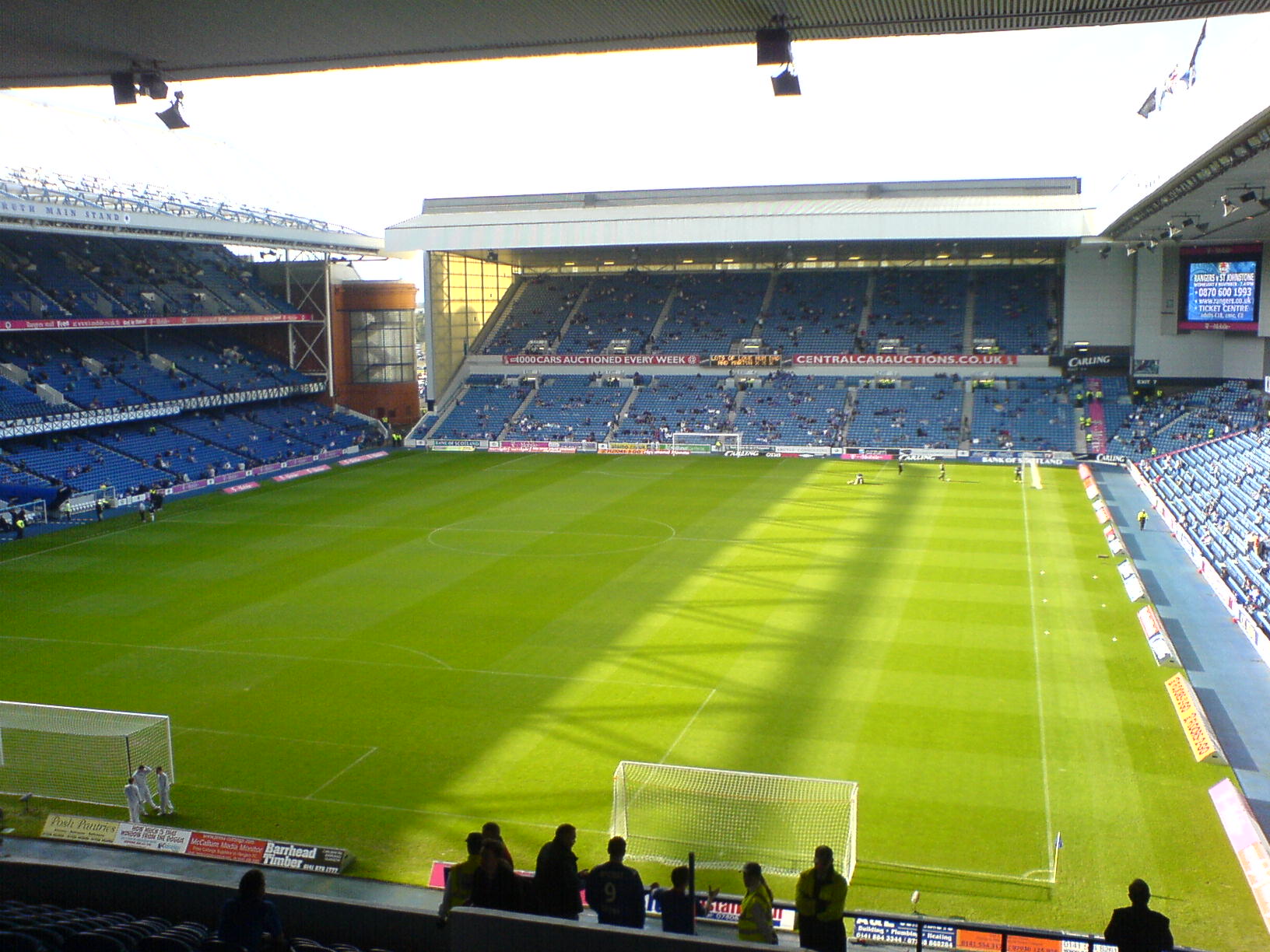
The photograph here shows the stadium in October 2006, not the 2003 team or celebrations. No verified reusable photograph of these particular finals is presented as event evidence.
The Rangers Museum offers a broader setting for this history, but individual displays change. Ask the venue about a particular trophy, shirt or match film before making it the reason for your trip.
Official source
- Rangers Archives: League Cup final, 16 March 2003
- UEFA: contemporary final-day championship report
- BBC: Rangers win to clinch title, 25 May 2003
- Rangers Archives: Rangers 6–1 Dunfermline
- Dunfermline Athletic: contemporary May 2003 match listing
- FBref: 2002/03 Rangers league totals
- Rangers: contemporary Scottish Cup final report
- UEFA: Scottish Cup victory and seventh domestic treble