
· Rangers, museum and archive accounts reviewed 15 November 2026
From Clydebank opponent to Rangers winger
Davie Cooper (1956–1995) was born in Hamilton and played for Clydebank before joining Rangers in June 1977. Rangers’ own account recalls his equaliser in a 3–3 League Cup draw at Ibrox in September 1976, when his ability was already attracting attention. Rangers needed two replays to get past Clydebank; the following summer Jock Wallace brought the winger to the club he supported.
That first Rangers season ended with the domestic treble. Cooper joined Bobby Russell and Gordon Smith as new arrivals in a side that won the league, Scottish Cup and League Cup in 1977/78. John Greig was still a player in that team before succeeding Wallace as manager. Cooper’s Ibrox career would continue through changes of manager and a long wait for another league championship.
John Greig: Cooper’s opponent, team-mate and manager
What made his left foot different
Rangers’ accounts describe a winger who could disguise his next movement, draw a defender towards the ball and then change direction. His crossing supplied chances for team-mates, while his shooting made him a threat in his own right. The point was not simply power: Cooper could make space where a defender seemed to have closed it off.
Two goals recur in the club’s tributes: his improvised finish against Celtic in the Drybrough Cup final on 4 August 1979 and his free-kick against Aberdeen in the 1987/88 League Cup final. Rangers records that supporters voted the 1979 strike their greatest Rangers goal in a 1999 poll. These were cup-final achievements, not matches at Ibrox; they belong to Cooper’s playing story rather than a list of famous home fixtures.
Honours without mixing clubs or seasons
Rangers’ 2020 tribute credits Cooper with 3 league championships, 3 Scottish Cups and 7 League Cups at the club. The league titles came in 1977/78, 1986/87 and 1988/89. In the 1986/87 title-clinching match at Aberdeen, it was his cross that Terry Butcher headed home: a contribution away from Ibrox that ended Rangers’ nine-year wait for the championship.
The Scottish Football Museum lists a further Scottish Cup win in 1991. That medal was won with Motherwell, not Rangers, so it must not be added to his Rangers honours. League Cup dates also need care: seasons can span two calendar years, and the museum’s list differs from the season-by-season finals in Rangers’ tribute. The article follows Rangers’ seven-medal total without treating those inconsistent year labels as separate wins.
Both the club and museum record 24 Scotland caps. His penalty against Wales in 1985 secured a play-off against Australia, rather than immediate qualification on that evening; Rangers’ fuller account makes that extra stage clear. He subsequently played at the 1986 World Cup in Mexico.
Why 540 appearances and 75 goals need attribution
Rangers’ 2020 tribute gives 540 games and 75 goals. The Rangers Archives’ player-record table also gives 540 competitive appearances, comprising 376 league, 49 Scottish Cup, 77 League Cup and 38 European matches. Those categories explain why a league-only figure is much smaller than a club-career total.
However, the archive’s individual Cooper page currently gives 541 competitive appearances and 76 goals, with 377 league appearances and 50 league goals. That is a one-match difference even within the same archive, not something that can safely be explained away as friendlies. We use Rangers’ 540/75 account with attribution and retain the 541/76 discrepancy here; the inspected pages do not identify the disputed fixture.
The Copland Road tributes and a lasting connection
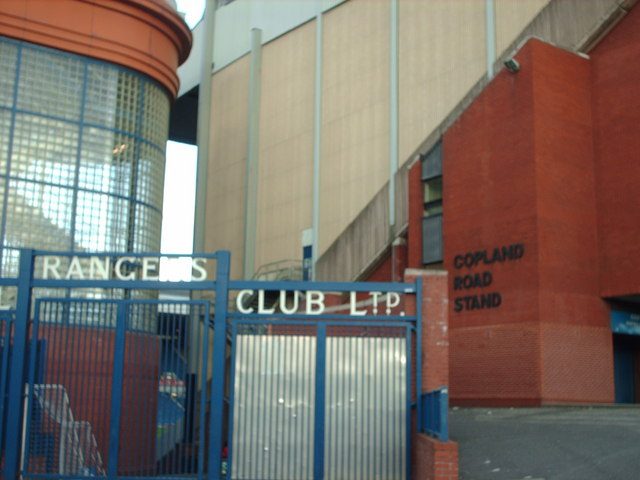
Cooper moved to Motherwell in 1989 and later returned to Clydebank. He died on 23 March 1995, aged 39. Rangers’ remembrance account records flowers and scarves at the Copland Road end of Ibrox. The stadium photograph here was taken in March 2008: it shows that part of the ground, not the tributes of 1995.
For a present-day visitor, his story adds another generation to the club history represented at Ibrox. The official accounts below include archive images and a RangersTV documentary; those photographs have not been copied here without permission. Our museum and tour guides provide current booking links, not a guarantee that a particular Cooper object or display will be available.
Rangers Museum and Edmiston House visitor information

Official source
- Rangers: Cooper — Gone But Not Forgotten (23 March 2020), honours and 540/75 record
- Rangers: Davie Cooper (23 March 2025), career and remembrance
- Scottish Football Museum: Davie Cooper biography
- The Rangers Archives: player records, 540 competitive appearances
- The Rangers Archives: Cooper player page, conflicting 541/76 breakdown