
· Rangers’ historical accounts reviewed 15 November 2026
What is the Rangers Loving Cup ceremony?
At the first home match of the year, Rangers directors and their guests gather in the Ibrox Blue Room to drink to the health of the reigning monarch. The vessel used for that toast is the Loving Cup: an object with a story quite different from the trophies won on the pitch.
Rangers’ account of the ceremony on 2 January 2024 records the directors of visiting club Kilmarnock taking part. Its January 2026 report describes Aberdeen as the guests and notes that the occasion had also been shared on the stadium screens in recent seasons. These are documented examples, not confirmation of the arrangements for a future fixture.
A cup made for the 1937 coronation
The cup’s story begins with Sir Francis Joseph, president of Stoke City. Rangers’ 2026 account says he commissioned W.T. Copeland and Sons at the Spode Works to produce 30 Loving Cups commemorating the coronation of King George VI and Queen Elizabeth on 12 May 1937.
The club’s earlier account explains that identical cups went to the 22 English First Division clubs of the time, with others presented to the British Museum and various organisations. Rangers’ cup therefore belongs to a small commemorative commission, rather than a competition in which the team defeated an opponent to win it. That distinction helps explain why its significance rests in the ritual and the circumstances of its presentation.
The charity match behind the gift
After the Holditch Colliery disaster in the Stoke area, Rangers were invited to play a special match against Stoke City to raise money for the dependants of miners who had died. The club’s account says manager Bill Struth accepted immediately; its 2026 retelling adds that Rangers bore their own travelling expenses.
Rangers records that the match finished goalless. Afterwards, Sir Francis Joseph presented the club with the last of the Loving Cups. His request was that it should be used in perpetuity for a toast to the reigning monarch before Rangers’ first home match of each year. The charitable purpose of the visit is central to the story: the cup connects a continuing Ibrox tradition with support for families affected by a tragedy elsewhere.
Why the Blue Room matters
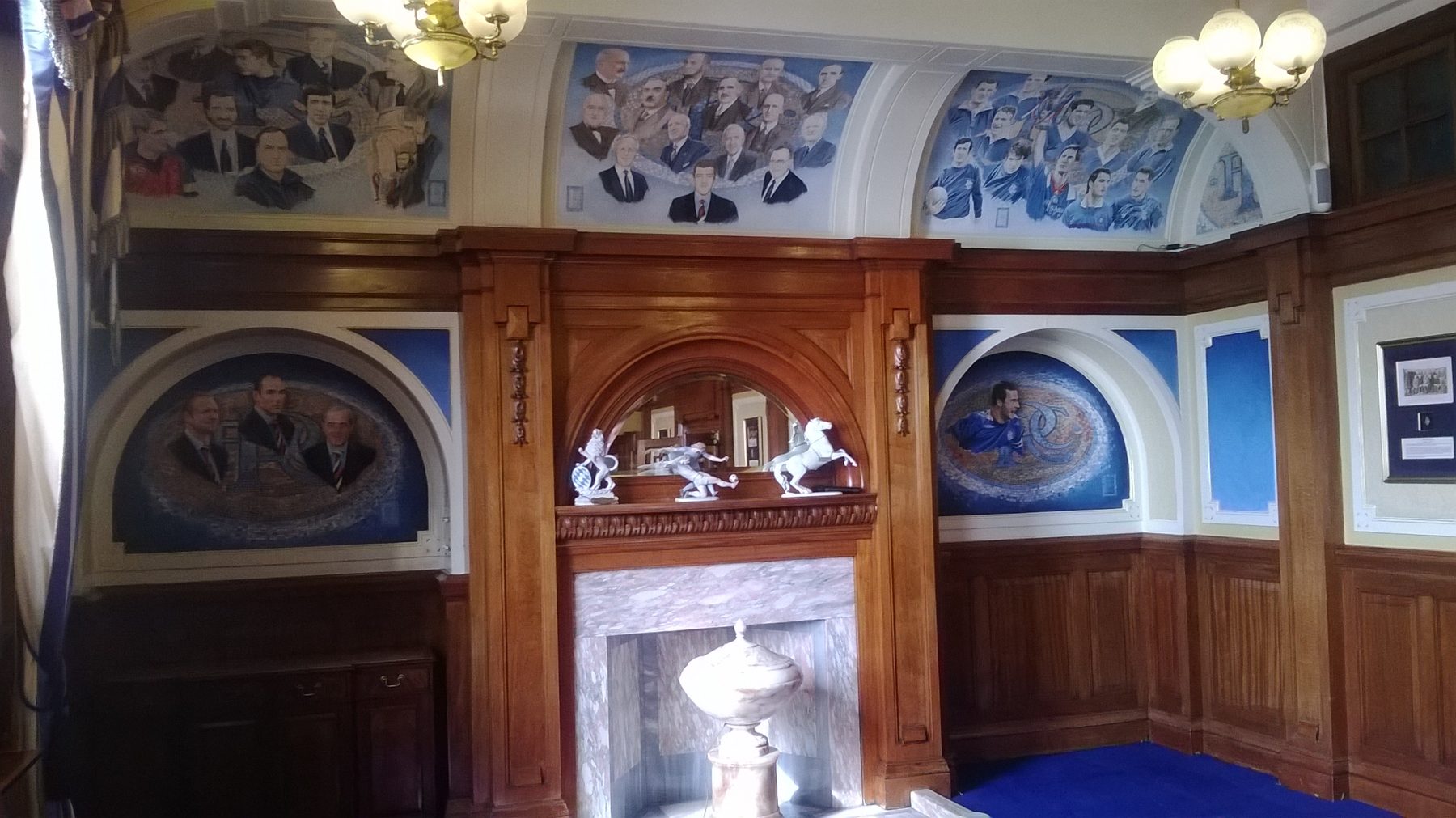
The setting gives the ceremony its Ibrox character. Inside the red-brick Main Stand, the Blue Room provides a smaller, more formal space than the seating bowl outside. The licensed photograph here shows its panelling and decoration in March 2014; it does not show a Loving Cup ceremony or establish where the cup is displayed today.
Our architecture article examines the room’s recorded interior details. Here, the room matters as the place where a gift from Stoke becomes part of Rangers’ annual calendar. A tradition held away from the pitch can carry as much historical meaning as the honours celebrated around it.
Learning about the tradition on a visit
The ceremony is not advertised here as a public event that readers can book. Its connection with the first home fixture does not guarantee admission to the Blue Room or a place among the guests. Use a new official announcement for any future ceremony rather than treating a past report as an invitation.
For a broader look at Rangers’ collections, our museum and stadium-tour guides link to the club’s current visitor information. They keep admission and access questions separate from this historical story. The official reports below are the starting point for the cup’s origins and the documented continuation of the toast.